
Celebrity hair transformations and the minoxidil question
Every few weeks, a film star or cricketer shows up with a thicker hairline, and the internet asks the same question: “Is he using minoxidil? Should I start it too?”
The latest name in this conversation is Vijay Deverakonda. On Shubhankar Mishra’s podcast during the Ranabaali promotions, he spoke about using minoxidil for his hair . But a celebrity’s routine is planned around their own scalp, by their own doctors. What we can tell you is how minoxidil works, who it really helps, and why starting it on your own can waste months.
In this short video, Dr. Vivin Prasadh (MBBS, MD), hair restoration specialist at Dheeran Hair Transplant Clinic, Coimbatore, answers this in Tamil.
[Embed video here]
What minoxidil is and how it works
Minoxidil is one of the most widely used medicines for male and female pattern hair loss (androgenetic alopecia). It is usually applied to the scalp as a solution or foam. Doctors sometimes prescribe a low-dose tablet form for selected patients.
It works in two main ways:
- It keeps hair in the growth phase longer. Thin, weak hairs get more time to grow thicker and longer.
- It improves blood flow around the hair follicle. Better supply helps miniaturised follicles produce stronger hair.
What it does not do: minoxidil does not block DHT, the hormone that drives pattern baldness. It also cannot create new follicles where the scalp is already completely bald and shiny.
Who minoxidil helps, and who it doesn’t
Situation | Will minoxidil help? |
|---|---|
Early thinning at the crown or hairline | Often yes — best results when started early |
Hair getting thinner but still present | Often yes — it thickens existing hair |
Completely bald, shiny areas | No — no follicles left to stimulate; a hair transplant may be the option |
Hair fall from thyroid, iron deficiency or stress | Not the main fix — the cause has to be treated first |
Dandruff or scalp infection causing hair fall | No — scalp treatment comes first |
After a hair transplant | Sometimes, only if your surgeon advises it |
That is why the first step is a proper scalp assessment, not a bottle from a pharmacy.
When you’ll see results, and the side effects to know
Minoxidil is slow. Most people need 4–6 months of daily use to judge it properly.
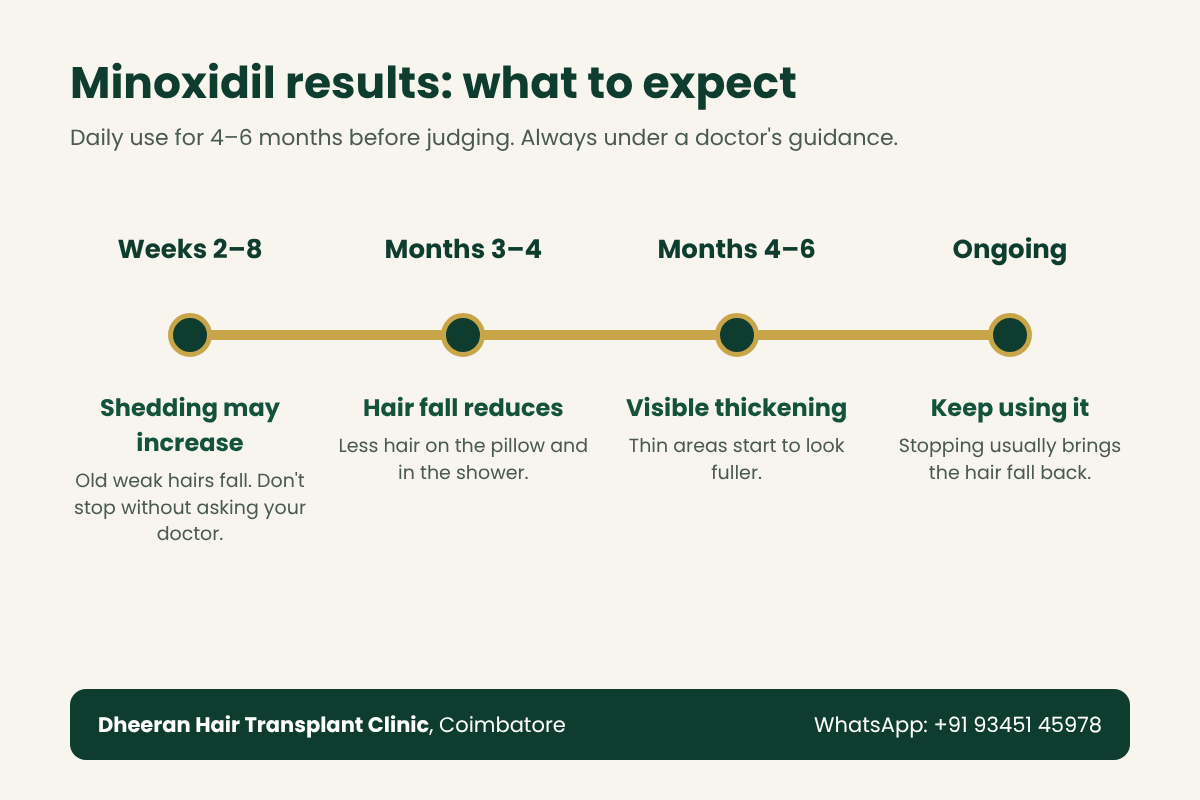
- Weeks 2–8: shedding may increase. Old, weak hairs fall to make way for new ones. Many people panic and stop here. Don’t stop without talking to your doctor.
- Months 3–4: fall reduces. You notice less hair on the pillow and in the shower.
- Months 4–6: visible thickening. Thin areas start to look fuller.
- Ongoing: it works only while you use it. If you stop, the gained hair usually falls again within a few months.
Common side effects:
- Scalp itching, dryness or flaking (often from the alcohol base)
- Unwanted facial or body hair, especially with tablets
- Rarely, dizziness, swelling of feet or a fast heartbeat — stop and see a doctor if this happens
People with heart conditions or blood pressure problems, and pregnant or breastfeeding women, should not use it without a doctor’s advice.
Why you shouldn’t start minoxidil on your own
Copying a celebrity’s routine skips the most important step: finding out why your hair is falling.
- Wrong diagnosis, wasted months. If your hair fall comes from thyroid problems, low iron, dandruff or stress, minoxidil alone won’t fix it.
- Combinations need a doctor. Minoxidil is often combined with other treatments, such as DHT blockers, GFC or other prescription medicines. Which combination suits you depends on your age, hair loss stage and health.
- Strength and form matter. Solution, foam or tablet, and the right concentration, should be chosen for you.
- Stopping and restarting causes loss. A clear plan from the start avoids this.
At Dheeran, every patient starts with a scalp analysis. Dr. Vivin then recommends medical treatment, a hair transplant, or both, based on your hair loss pattern and donor area.
Frequently asked questions
Can minoxidil regrow hair on a completely bald area? No. It works on thinning hair that still has active follicles. Fully bald areas usually need a hair transplant.
Is minoxidil safe for long-term use? For most healthy adults, topical minoxidil is used long term under a doctor’s guidance. Your doctor will check if it suits you.
Will my hair fall if I stop minoxidil? Usually, yes. The extra hair it maintains tends to shed within a few months of stopping.
Do I need minoxidil after a hair transplant? Not always. Some patients benefit from it to protect existing hair. Follow your surgeon’s advice.
Book a consultation
Not sure if minoxidil, a hair transplant or both is right for you? Get your scalp checked by Dr. Vivin Prasadh.
- WhatsApp: Book on WhatsApp
- Call: +91 93451 45978 (9:30 AM – 6 PM)
- Clinic: 2nd Floor, Malar Medical Centre, GV Residency Link Road, Sowripalayam, Coimbatore – 641028
- Consultation: 2 PM – 6 PM, by prior appointment only
Disclaimer: This article is for awareness only. Do not start or stop any medicine without consulting a qualified doctor.

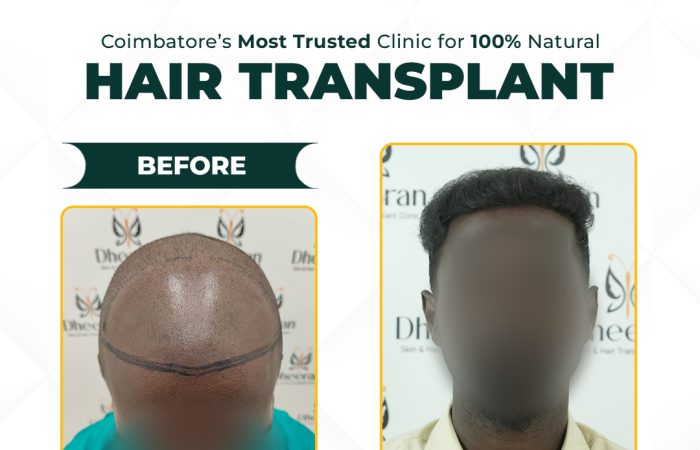
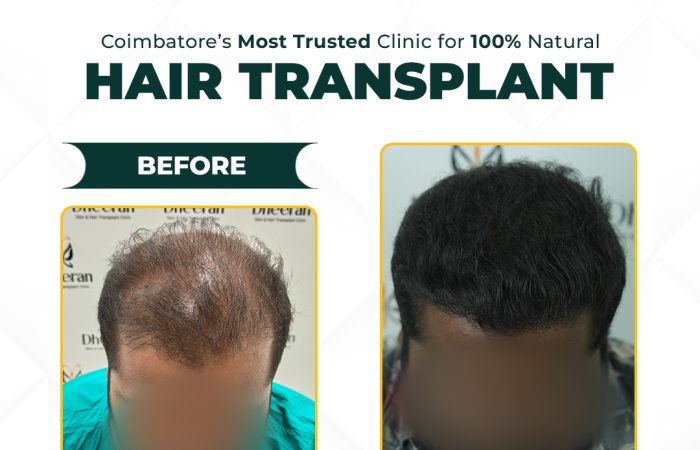



Patient Testimonials & Results
▶ Watch All Videos









 Dr. Vivin Prasadh